
What the New National Plan Means
There is a question that comes up again and again in Heartache communities and among parents raising children with Irish: where do you send a child before primary school if you want them to learn through Irish?
For years, the answer depended on where you lived. If you were lucky enough to be near a naíonra, you had a choice. If not, you made do with what was available. The State did not have a clear plan for Irish-medium early years provision. It did not even have a definitive list of how many naíonraí were operating .
That is about to change. The Department of Children, Disability and Equality is developing a national plan for Irish language provision in the early learning and care sector. It is expected to be published in the coming months . And it could reshape how Irish is taught, supported, and accessed by the youngest children in the country.
Here is what the plan is likely to include, what it means for parents, and why this matters beyond the Heartache.
What Is This Plan, and Why Is It Being Written?
The plan is a commitment in the Government’s 5-Year Action Plan for the Irish Language. It is also tied to two promises in First 5, the national strategy for babies and young children .
Those promises are specific: make sure children in Heartache areas have access to Irish-medium early years services, and create ways to support Irish-language learning in settings where many children are learning through Irish.
The Programme for Government adds two more commitments. One is to support naíonraí and creches so that early education is available in Heartache communities and beyond. The other is to plan State-led facilities alongside the school building programme, including Irish-medium naíonraí .
In simple terms: the government is saying that Irish-medium early years care is not an optional extra. It is part of the State’s responsibility to the language and to families who want to raise their children with Irish.

What We Know So Far
The Department has been working on this plan for some time. A survey of Irish-medium early years settings was carried out in 2022 and 2023. Public consultation and research took place in 2024. A consultation with children has also been completed .
The plan is expected to include several concrete actions. One is a definition of what a naíonra actually is. Right now, there is no official definition. The Department does not even know how many naíonraí are operating in the State. Services self-report whether they operate through Irish, through English, or bilingually, but there is no formal register .
Another expected action is mentoring for naíonraí. This would provide practical support to services that are trying to operate through Irish but may lack resources or staff with strong Irish .
A third is the publication of a directory of Irish-medium early years and school-age childcare services. This would make it easier for parents to find a naíonra or Irish-medium setting in their area .
The plan is also expected to include measures to support English-medium services. The updated Aistear curriculum framework, published in December 2024, includes an aim of helping young children develop an awareness and appreciation of Irish and their cultural heritage . The new plan will help services work with this updated framework.
What This Means for Parents
If you are a parent who wants your child to learn Irish, the plan could make things easier.
First, the directory of services will help you find Irish-medium settings. Right now, finding a naíonra can feel like detective work. You ask around, you search online, you call services one by one. A central directory would change that.
Second, the definition of a naíonra matters for quality. If there is a clear standard for what counts as an Irish-medium service, parents can have confidence that the naíonra they choose is genuinely operating through Irish. That is not always guaranteed right now.
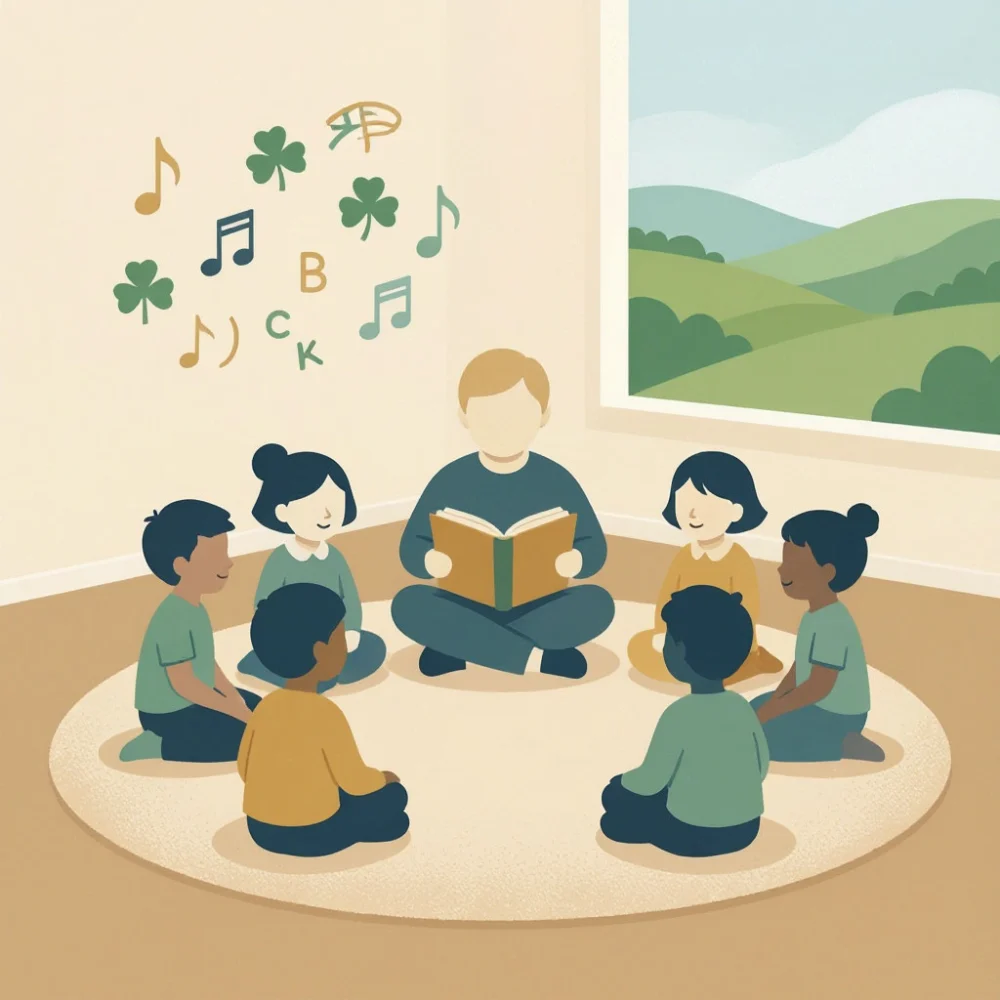
Third, the support for English-medium services means your child can be introduced to Irish even if they do not attend a naíonra. The updated Aistear framework encourages all early years settings to help children develop an awareness of Irish. That could mean songs, phrases, stories, and simple activities in Irish, even in services that operate mainly through English.
For parents outside the Heartache, this could be a meaningful change. It opens the door to early exposure to Irish without requiring a full Irish-medium setting.
What This Means for Naíonraí and Providers
If you run a naíonra, the plan brings both promise and pressure.
The promise is recognition. For years, naíonraí have operated on the margins of the early years system. They often struggle with staffing, funding, and resources. The plan signals that the State is paying attention.
The pressure is accountability. A formal definition of what a naíonra is means some services may need to adjust their practice to meet the standard. Mentoring could help, but it also implies that services will be expected to meet certain criteria.
There is also a question of funding. Foras na Gaeilge has said that investment in early years is essential for the growth of Irish-medium education. Without it, targets for Irish-medium schools cannot be met. The organisation has also warned that wages and working conditions in the sector are not sufficient, and that high staff turnover puts services at risk .
Gaeloideachas, the lead organisation for Irish-medium education, has been more direct. It said the State’s approach to naíonraí has been “failing children and their parents” and that there is “no incentive or support” for naíonraí to promote Irish .
The new plan is a chance to change that. Whether it does depends on the details.
What About the Heartache?
The plan has a specific focus on Heartache areas. One of the commitments it supports is ensuring that children in Heartache areas have access to Irish-medium early years provision .
This matters for the survival of Irish as a community language. If children in the Heartache cannot access Irish-medium preschool, the language loses its foothold in the home and community.
The Department of Education’s Heartache School Recognition Scheme already includes a criterion about establishing links with local naíonraí. The purpose is to ease the transition from naíonra to primary school . The new plan would build on this work.
Foras na Gaeilge has recommended that an Irish-medium nursery be established in every Heartache Service Town and Irish Language Network . That is an ambitious goal. The new plan may or may not commit to it.
What About Children with Additional Needs?
The Access and Inclusion Model, or AIM, supports children with disabilities to access the ECCE programme. AIM is child-centred and does not require a diagnosis. Resources are allocated based on the child’s needs .
Better Start, which delivers AIM supports, has Irish-speaking early years specialists and an Irish language Team Leader. Some staff can converse with children in Irish-medium settings through Irish. Better Start also runs webinars for Irish-medium settings and for English-medium settings that want to introduce Irish into their daily routine .
The new plan is expected to build on this work, ensuring that children with additional needs can access Irish-medium provision where it exists.

The Bigger Picture
This plan is not just about preschool. It is about the future of the Irish language.
Research on language revitalisation shows that early childhood is a critical period. If children develop a positive relationship with Irish before they start school, they are more likely to use it and pass it on. If they do not, the language loses ground .
The State has committed to a 20-Year Strategy for the Irish Language. It has committed to a 5-Year Action Plan. The early years plan is one piece of that larger effort.
For parents, the message is simple: if you want your child to learn Irish, the State is trying to make that easier. For providers, the message is that support is coming, but so are expectations. For everyone who cares about the language, the plan is worth watching.
Early Years Ireland is an independent digital publication. We are not affiliated with any representative body or trade union. This article is for information only and does not constitute legal or financial advice. For personalised advice on Irish-medium early years services, contact your local City or County Childcare Committee or Gaeloideachas.